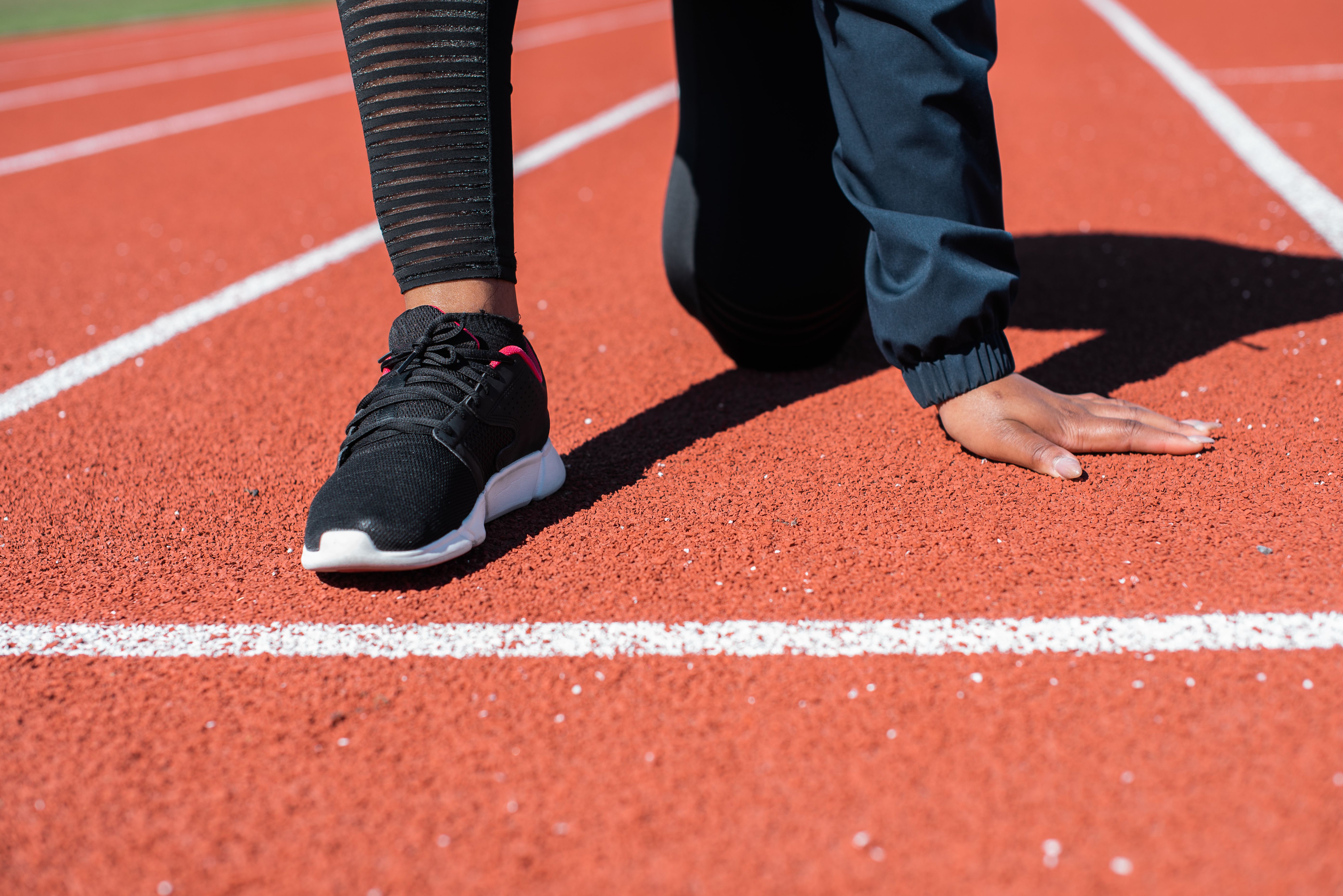
If you've had ACL reconstruction, somewhere between the surgeon clearing you and the moment you actually trust your knee again, there's a gap nobody prepares you for. I know it from the inside: a decade of professional handball across two national team programs came with more than one stretch of "you're cleared, go play" that didn't match how my body actually felt. The paperwork said ready. My knee didn't agree yet.
If you're reading this after an ACL reconstruction, you've probably already heard the headline number: most people who return to competitive sport do it inside a year. What you don't hear as often is the other number, how many of them get hurt again, and why. That second number is the one worth understanding before you rush back.
Why this matters more than "just get back out there"
The re-injury numbers are higher than most people expect. A large meta-analysis found second ACL injuries hit around 15% of everyone who returns to sport, but that number jumps hard for younger athletes: under 25, it's roughly 21-23%, better than one in five (Wiggins et al., 2016). A separate systematic review of more than 1,200 athletes younger than 20 found the same kind of problem: a meaningful number of young athletes reinjured either the graft or the other knee during follow-up (Barber-Westin & Noyes, 2020).
In plain English: most athletes do not need to live scared of a second injury, but the risk is not a small detail you can ignore. Especially if you're young and play a sport with cutting, jumping, contact, or fast direction changes, return to sport should not be reduced to "has enough time passed?"
Return-to-sport rates tell a related story, but they need to be read carefully. A large systematic review pooling nearly 50 studies found this: 82% of athletes get back to some form of sport, but only 63% return to their actual pre-injury level, and only 44% return specifically to competitive sport (Ardern et al., 2011).
Those are not the same thing. "I returned to sport" can mean light training, recreational play, or getting back without full intensity. "I returned to my previous level" is a much stricter standard. That's why the gap between "cleared" and "actually back to your sport, at your level" matters so much. And it is not just about the knee: fear of re-injury is one of the most common reasons athletes cited for not getting back to where they were, even when their knee function tested out fine.
None of this is meant to scare you. It's meant to explain why "return to sport" isn't a single date on a calendar. It's a process with real decision points, and the research is unusually clear about what actually moves the needle.
The phases that matter
I'm not your surgeon or your physical therapist, and nothing here replaces the early clinical stages of your recovery. The first few months after reconstruction are their territory, not mine. Where a movement coach like me fits in is later: once your medical team has you moving well and pain-free, and the question becomes how do we rebuild strength, movement quality, and confidence in a way that actually holds up under sport? That's the phase this article is really about.
Phase 1, Medical clearance and early strength restoration (roughly months 0-3)
This stage belongs to your surgeon and physical therapist. Swelling control, range of motion, early quad activation, protecting the graft while it matures. This is clinical work, and it should stay that way. If you're still in this window, the most useful thing I can tell you is: don't rush it, and don't let anyone (including yourself) skip it because you feel okay on a given day. The tissue timeline doesn't care how good you feel.
Phase 2, Rebuilding strength symmetry and movement quality (roughly months 3-6)
Once you're cleared for more general strength work, this is where the numbers start to matter. One of the most common benchmarks in the research is the 90% rule: quadriceps and hamstring strength on the reconstructed leg should be close to the other leg, usually at least 90% (Lynch et al., 2013).
That does not mean 90% is a magic line that automatically makes you ready. It simply means a big gap between legs is usually not a good sign for returning to sport. If one leg is still doing much less work, the body often finds a way to hide it: shifting weight, changing the landing, bracing, or avoiding the side that does not feel trustworthy yet.
This is also where I can genuinely help: identifying where your body is compensating, favoring the good leg, avoiding certain ranges, bracing instead of moving freely, and building a program around closing those gaps. I'll describe what I see in how you move; I won't diagnose what's happening inside the joint. That line matters, and it's one I take seriously.
Phase 3, Sport-specific loading and hop-test progression (roughly months 6-9)
This is where training starts looking more like your sport again, cutting, deceleration, jumping and landing mechanics, reactive movement. The classic testing battery used throughout this research field is a set of single-leg hop tests, single hop, triple hop, crossover hop, and a timed hop, originally established by Noyes and colleagues back in 1991 and still the backbone of hop testing today.
This is also usually where confidence either starts coming back or starts cracking. Straight-line strength in the gym doesn't automatically transfer to cutting hard on a compressed timeline mid-play, the exact moment a handball or football decision actually happens. Closing that gap, gym strength to game-speed decision-making, is a big part of what this phase is actually for, and it's a slower process than most athletes expect walking in.
Phase 4, Formal return-to-sport testing (9+ months)
Here's the number worth remembering: research consistently points to 9 months as a meaningful threshold, not an arbitrary one. One study found reinjury risk dropped by roughly 51% for every additional month return was delayed, up to about 9 months. After that, simply waiting longer did not seem to add the same benefit (Grindem et al., 2016). A separate study followed young athletes and found that those who went back before 9 months had roughly seven times the rate of new injury compared with those who waited (Beischer et al., 2020).
Practically, this does not mean you just sit around and wait for 9 months. It means coming back too early carries a real risk, and those months need to be used for strength, movement quality, testing, and trust, not just time passing.
At this stage, athletes are usually not judged by one test. They are looked at through several signals at once:
- whether quad and hamstring strength are close enough to the other leg
- whether hop tests show good control and symmetry
- whether the athlete reports that the knee feels functional, not just fine on paper
- whether running, landing, and direction changes look stable
Research often uses the 90% mark for strength and hop tests, plus a high knee-function score (Grindem et al., 2016). A separate study of 158 elite male professional athletes found something similar from another angle: fall short on even one of six return criteria, and the odds of tearing the graft again rise roughly fourfold compared with athletes who cleared all six (Kyritsis et al., 2016).
Here's the honest part. Meeting these numbers helps. In Grindem's study, only 5.6% of athletes who passed the full criteria suffered a second injury. In the group that did not meet the criteria, that number was 38.2% (Grindem et al., 2016). That is a big difference.
But the story does not end there. The problem is that some tests can look better than they really are.
The easiest example is LSI, or limb symmetry index. It compares your reconstructed leg to your other leg. On paper, that sounds logical: if the injured leg is at 90% of the other leg, you look close. But what if the other leg also got weaker during months of recovery? Then you are not comparing the injured leg to a truly strong leg. You are comparing it to a leg that may also be below your old level.
That is why one study compared two things: standard leg-to-leg symmetry, and a stricter comparison against estimated pre-injury strength. The result was huge: 57.1% of athletes passed the standard leg-to-leg comparison, but only 28.6% passed the stricter pre-injury-based benchmark. More importantly, the stricter measure did a better job predicting who actually got reinjured (Wellsandt et al., 2017).
Several other studies point in the same direction. Many athletes get cleared to return, but when they are checked against a full set of strict criteria, far fewer actually meet all of them (Toole et al., 2017). A 2025 analysis found that limb symmetry tests by themselves often struggle to reliably separate who will and will not get reinjured (Simonsson et al., 2025). A 2023 study of over 400 athletes went even further and found no clear link between passing a standard return-to-sport test battery and actually staying injury-free (Piussi et al., 2023).
Put simply: tests are useful, but they are not a crystal ball. A good result tells you that you are probably on a better path. It does not tell you the story is over.
None of this means testing is pointless. It means treating a passed hop test as a green light to stop paying attention is a mistake. Symmetry with a weaker "good" leg isn't the same as being strong.
Phase 5, Rebuilding trust, not just strength
This is the phase people talk about least, and it might matter as much as anything above. Researchers developed a specific tool, the ACL-RSI scale, to measure psychological readiness to return to sport: how much fear you're carrying, how confident you feel in your knee, how you weigh the risk (Webster et al., 2008). In athletes 20 and under, lower psychological readiness scores at the 12-month mark have been linked to a higher chance of a second injury (McPherson et al., 2019).
If you are not used to reading research scales, the basic idea is simple: it is not enough that the knee can perform a movement in controlled conditions. It also matters whether you trust that movement when the game speeds up, when there is no time to think, and when the body has to react automatically.
Interestingly, the opposite extreme carries its own risk. One recent study found that athletes who scored very high on confidence just 3 months after surgery, well before real readiness, actually had a higher rate of second injury two years later than those with more measured confidence at that early stage (Ueda et al., 2024). Overconfidence early in recovery seems to be its own hazard, distinct from underconfidence near the end of it.
This is, honestly, the part of the process that lines up most with how I coach, not because I'm a therapist (I'm not, and I won't pretend to be), but because ten years of elite sport taught me that the gap between "my knee is structurally fine" and "I trust my knee enough to plant and cut without hesitating" is a real, physical thing, not just a mindset problem to push through.
What this means for your return to sport
If there's one thing I'd want you to take from the research, it is this: return-to-sport is not a single test you pass on one good day.
It is better to see it as a slow rebuild of three things:
- strength, not just compared with your other leg, but compared with what your sport actually demands
- movement quality, so your body is not constantly finding ways around the problem
- trust, because a checklist does not mean much if you still hesitate as soon as the game speeds up
The 9-month mark is real and worth respecting. But it is just as important to remember that good numbers are not the end of the story. Some things only show up when speed, contact, fatigue, and pressure come back.
None of these five phases run on a fixed clock, and they overlap more than the list above makes them look. A cautious Phase 2 doesn't have to mean a delayed Phase 5; confidence work can start well before a hop test does. What matters more than hitting each phase on schedule is not skipping the parts that are harder to measure, especially the last one.
I work with athletes in that rebuilding phase, after your medical team has done their part, when the question shifts from "is the joint healed" to "can I actually perform again, and do I believe it." If that's where you are, I'd like to hear where you're at.
Frequently asked questions
Is 9 months a hard rule for everyone? No. It's a well-supported minimum threshold from research on when reinjury risk meaningfully drops, not a guarantee or a fixed deadline. Some athletes need longer. The timeline should be set with your surgeon and physical therapist based on your actual recovery, not a calendar.
If I pass my hop tests and strength tests, am I safe to return? Passing helps. The research is clear that criteria-based clearance beats a purely time-based decision. But newer research shows standard symmetry testing can overestimate readiness if your uninjured leg has also weakened during recovery. Treat a passed test as one good sign among several, not a guarantee.
Can a coach like you help before I'm medically cleared? No, and I wouldn't try. The early stages of ACL recovery are clinical territory: that's your surgeon's and physical therapist's work, not mine. Where I come in is later, once you've been cleared for general strength and movement work, and the focus shifts to rebuilding strength, movement quality, and confidence for sport.
Why does fear of re-injury matter if my knee tests out fine? Because hesitation changes how you move. Research links psychological readiness scores to actual reinjury risk, and separately, fear of re-injury is one of the most commonly cited reasons athletes never return to their previous level even when their knee function is objectively fine. It's not "just in your head" in the dismissive sense: it's a measurable part of the picture.
Is testing at 3 months post-op useful? It can be, but interpret high confidence at that stage carefully. At least one study found athletes who felt very confident that early actually had a higher second-injury rate later, likely because that confidence outpaced actual tissue and neuromuscular readiness, not because confidence itself is bad.
What if I don't have access to formal hop-test or strength-testing equipment? Not every gym or clinic has isokinetic dynamometers or a proper hop-test setup, and that's a real, common limitation, not a reason to skip testing altogether. Ask your physical therapist what they can measure with what they have (a simple handheld dynamometer and a tape measure for hop distance cover a surprising amount of ground), and be honest with yourself about estimating symmetry by feel alone. It's an imperfect substitute, but it's better than guessing blind.
Sources: Wiggins et al. 2016 (PMID 26772611); Barber-Westin & Noyes 2020 (PMID 32374646); Piussi et al. 2023 (PMID 37547843); Ardern et al. 2011 (PMID 21398310); Lynch et al. 2013 (PMID 23881894); Grindem et al. 2016 (PMID 27162233); Noyes et al. 1991 (PMID 1962720); Beischer et al. 2020 (PMID 32005095); Kyritsis et al. 2016 (PMID 27215935); Wellsandt et al. 2017 (PMID 28355978); Toole et al. 2017 (PMID 28990491); Simonsson et al. 2025 (PMID 39797641); Webster et al. 2008 (PMID 19083699); McPherson et al. 2019 (PMID 30753794); Ueda et al. 2024 (PMID 38584989).
Ragukai Method
Curious how this shows up for you?
I put together a short self-assessment that takes about 3 minutes, for a personal read on your own situation, not a generic score.